The Revenue Extraction Prompt We Built in 2024 - Still Pulls Company Revenue for $0.01 per Lookup

Bhanu Singh
6 min read · 5 Aug 2026
Some prompts age like milk. This one aged like a well-oiled machine. Built at Senko GTM in 2024 and still running clean two years later.
Every GTM engineer has run into the same wall.
You have a list of 5,000 companies. You need revenue on each of them. You open ZoomInfo - blocked behind a paywall. You open PitchBook - blocked behind a bigger paywall. You try to pull it from Clay - the enrichment credit burns through your budget in a single run.
So you sit there thinking - there has to be a cheaper way.
Back in early 2024, that's exactly the problem we were solving at Senko GTM. And the answer we landed on was almost embarrassingly simple - a well-structured LLM prompt, pointed at the open web, priced at fractions of a cent per lookup.
Two years later that prompt is still in production. Still hitting the same accuracy. Still costing between $0.006 and $0.015 per company in OpenAI usage.
Here's how it works.
The Real Cost Problem
Before the prompt, let's talk numbers - because this is where most people give up on this problem before they even start.
Commercial enrichment tools charge anywhere from $0.10 to $0.50 per revenue lookup depending on the vendor and the volume tier. Multiply that across a 5,000 company list and you're staring at $500 to $2,500 for a single enrichment pass. Do it monthly and it becomes a real line item.
Now compare that to $0.006 to $0.015 per company through a well designed LLM prompt.
Same 5,000 company list. Total cost - $30 to $75. Same accuracy on the companies that have public revenue data available. And you own the workflow end to end.
That's the delta this prompt was designed to close.
The Design Principle - Waterfall, Not Guess
The critical insight - and the reason this prompt outperforms a naive "just ask the LLM for revenue" approach - is that we forced the model into a strict search hierarchy instead of letting it hallucinate.
Two stages. First stage tries the trusted structured databases where revenue data is verified. Second stage falls back to a scoped Google search only if the first stage returned nothing.
If both fail, the prompt returns "not found" cleanly. No hallucinated numbers. No made up revenue figures that break your downstream scoring.
That last part is why this thing works. Most people write a prompt that says "find the revenue" and the LLM confidently invents a number. We wrote a prompt that says "find the revenue from these specific sources in this specific order, and if you cannot, say you cannot." Small change. Massive accuracy difference.
Prompt 1 - The Primary Trusted Database Search
The first prompt in the waterfall targets six structured revenue databases in a defined priority order. PitchBook and Dealroom sit at the top because they are the most verified. GrowJo sits at the bottom because it uses estimation models.
Input Data Format:
- [Company Name]:
- [Company Domain]:
Instructions:
1. Search Directly on Trusted Platforms
- Look up "[Company Domain]" on:
- RocketReach (https://rocketreach.co/)
- Dealroom (https://dealroom.co/)
- ZoomInfo (https://www.zoominfo.com/)
- GrowJo (https://www.growjo.com/)
- PitchBook (https://pitchbook.com/)
- Tracxn (https://tracxn.com/)
- If [Company Name] is available, use it to refine the search.
- Extract the most recent revenue data in USD from the most authoritative source available.
2. Source Ranking and Selection Criteria
- Prioritize structured databases in the following order: PitchBook > Dealroom > ZoomInfo > Tracxn > RocketReach > GrowJo
- If multiple sources report different revenue figures, choose the one with the latest and most verified data.
- Avoid estimates from non-authoritative sources (e.g. user generated figures).
Note: Always output the revenue with currency symbol.
3. Output Requirements
- If revenue data is found, return:
Revenue: $[Amount] USD (Source: [Platform Name]) - If no revenue data is available from any source, return:
"not found"
The reason we ranked the sources this way - PitchBook data goes through actual analyst review. Dealroom is close behind. ZoomInfo and Tracxn are algorithmically compiled but usually well sourced. RocketReach and GrowJo are estimation heavy, so they sit at the bottom as a last resort inside the trusted tier.
Prompt 2 - The Google Fallback
If Prompt 1 comes back with "not found", we pass the company through the second prompt. This one runs an advanced Google query with site restrictions and phrase permutations to catch revenue mentions that were not indexed on the trusted platforms.
Input Data Format:
- Company Name: [Company Name]
- Company Domain: [Company Domain]
Instructions:
1. Advanced Google Search (Wider Query Scope)
Expand the search with the following broader queries:
Query A: ("[Company Name]" revenue OR "[Company Name]" annual revenue OR "[Company Name]" estimated revenue OR "[Company Name]" revenue in * million OR "[Company Name]" revenue in * billion") (site:dealroom.co OR site:zoominfo.com OR site:growjo.com OR site:pitchbook.com OR site:tracxn.com)
OR
Query B: ("[Company Name]" revenue OR "[Company Name]" annual revenue OR "[Company Name]" estimated revenue OR "[Company Name]" revenue in * million OR "[Company Name]" revenue in * billion") AND "[Company Domain]"
- Extract the most reliable and recent revenue data from the search results.
- If multiple figures appear, prioritize the most recent data from an authoritative source.
Note: Always output the revenue with currency symbol.
3. Output Requirements
- If revenue data is found, return:
Revenue: $[Amount] USD (Source: [Website Link]) - If no revenue data is available, return:
"not found"
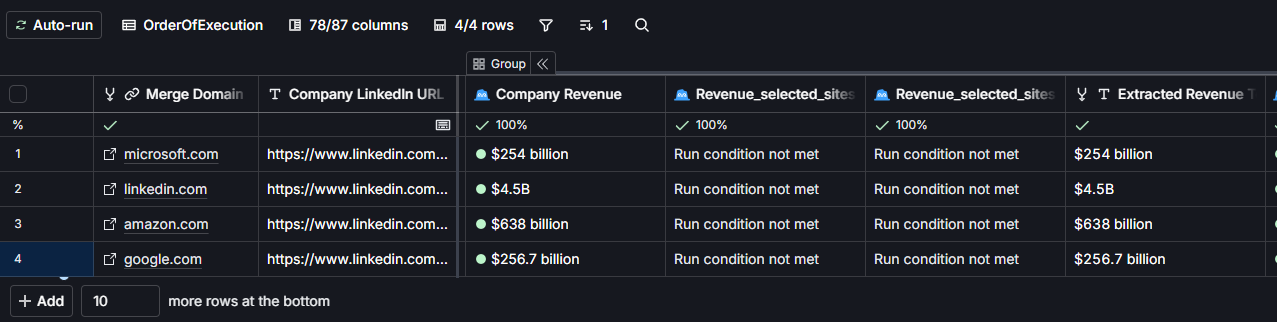
The wildcard revenue in * million pattern is doing a lot of work here. It catches phrasings like "revenue in 45 million dollars" or "revenue in 3.2 billion" that a rigid keyword match would skip. And the two query variants give the LLM a way to fall back from strict site restrictions to a broader domain constrained search.
Why the Waterfall Works Better Than a Single Prompt
We tested this both ways in 2024. Single mega prompt versus 2-stage waterfall.
The waterfall won on two dimensions.
First, accuracy. When you force the model to try the structured sources first, you get verified figures. When it falls through to Google, you know you are dealing with a lower confidence tier and you can flag it downstream. A single prompt blends both and you lose that signal.
Second, cost. Prompt 1 hits for roughly 70% of companies in a typical B2B list. Those companies never touch Prompt 2. You only pay for the second call on the 30% that need it. Average blended cost lands in that $0.006 to $0.015 range depending on which model you route through.
How to Actually Run This in Production
A few operator notes that matter if you are going to plug this into a real workflow.
Route Prompt 1 through a model with browsing or search grounding turned on - otherwise the LLM cannot actually reach RocketReach or PitchBook and will hallucinate. In 2024 we used GPT-4 with browsing. In 2026 the equivalent is any of the current models with a search tool attached.
Cache the results. If you enrich the same domain twice in a month, you are wasting a call. A simple domain -> revenue key value store cuts your bill in half over time.
Log the source. The prompt returns (Source: PitchBook) for a reason. Downstream, you want to know whether a revenue figure came from an analyst reviewed database or from a Google snippet. Treat them differently in your ICP scoring.
And accept the "not found" returns as a feature. Roughly 15-20% of a mid market B2B list will genuinely have no public revenue data available. Forcing a number in that gap is worse than a clean null.
What This Actually Proves
This prompt is two years old and still in production. Nothing in it has changed. That's the interesting part.
The underlying insight was not "use AI to find revenue." The underlying insight was "constrain the AI to specific verified sources in a specific priority order, and give it a clean way to say I don't know."
That structural discipline is what makes prompts age well. Most 2024 prompts break by 2026 because they were designed loosely. This one still runs because it was designed with guardrails.
At Senko GTM this is the pattern we use across dozens of enrichment prompts - revenue, headcount, tech stack, funding stage, hiring signals. Same principle every time. Trusted sources first. Fallback second. Clean nulls when nothing is available. Fractions of a cent per lookup.
The prompt above is yours to take and use. If you want to plug this kind of low cost enrichment into a live outbound workflow, that's what we do at Senko GTM - and this is the exact playbook we start from.
Free sample · no call required
Want to see this applied to your desk?
Get a free sample list of companies hiring in your niche right now — decision makers and verified emails included.
Get my free sample